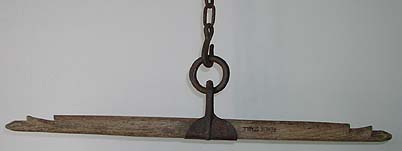
What is it?
After hogs were bled,
scalded, and scraped, they were generally hung by the hind legs to be eviscerated and then cooled overnight. A slit was made just above the hoof joint to make a hole between the bone and tendons. A crude gambrel, often made by sharpening the ends of a sapling with an ax, was then inserted to keep the hind legs separated and provide a means to hoist the carcass with a block and tackle tied to a large tree limb. This white oak gambrel is one of a pair made on our farm around 1900. It was shaped carefully with a drawknife and fitted with hand forged hardware. It was even branded "Remlik Stables" to discourage disappearance. Notches keep the tendons from slipping off and dropping the meat when the carcass is split. The trace chain and hook shown here were also forge made and welded on the farm.