The Cure and Country Ham

Methods of naturally curing pork vary greatly in different areas because of climate and other variables. Since curing conditions are unpredictable, the methods I will describe are more art than science and procedures are admittedly vague. The general principles are pretty simple, though, and there is plenty of room for variations. In the Tidewater area of Virginia, hogs are killed from mid-November to late January. We try to pick a time when cold weather has settled in but we do not expect it to get too cold. Once meat has frozen, it does not take the cure properly and extended periods of warm weather (50° F ambient) before the cure has penetrated will spoil the meat. Fresh meat freezes at 28° F but as the cure is absorbed, the freezing temp is lowered. The ideal conditions for the first phase, taking the cure, is about 38° F with relatively high humidity. The curing process stops at meat temperatures below 34° F and curing time must be increased to compensate. Time varies depending on the cut and weight from 2 weeks min. for bacon to over two months for large hams. After the initial cure, the meat can stand the seasonal warm-up through the aging process.

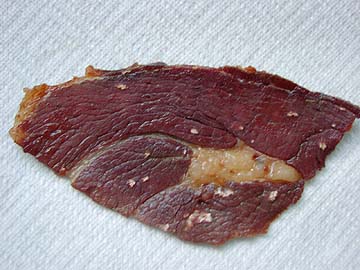
Good cures start with good meat. We raise our own hogs and fatten them on a corn-based ration supplemented by whatever is available - stale bakery products, household garbage, etc. Garbage should not dominate the ration, as the fat will be soft. Top hogs weigh 220 pounds and yield about a 16 pound ham. We like to cure hams between 20 and 30 pounds. Large hams with adequate fat layers age better and don't dry out as much during extended storage. Country cured hams will keep indefinitely but achieve their full flavor after about one year when "white flecks" appear in the muscle. We feed our hogs to 300 pounds or better but don't let them get too fat. Some cuts may be slightly tougher with heavy hogs. Hams, shoulders and bellies may be bought from packing houses and can be ordered by butchers if you are not in a position to grow your own. You may have to buy box lots but make absolutely sure that the meat is fresh and quickly chilled. Pork should be put in cure as soon as possible after chilling and trimming but, properly handled, it can be a couple of days old. I once bought ten, 25 pound hams that had been two days in transit to the butcher and then were left in his cooler over the weekend. I lost the whole batch! Those hams had also been trimmed excessively leaving little skin and fat covering. As a result, I have gone back to raising my own so I know what I have to work with.

Curing and smoking facilities vary greatly. Traditional farm ham houses / smokehouses are windowless wood frame buildings about ten feet square with a dirt floor. Wooden plank benches provide work areas for mixing the cure and salting down meat. Joists are within reach and studded with 20 penny nails for hanging meat. The dirt floor allows a higher humidity in winter and allows a smoldering fire to be built inside - both for smoking and to keep meat from freezing during extreme cold. Some ham houses have external smoke generators - simply a firebox with a stovepipe stuck through the wall. This arrangement makes it easier to cold smoke for several days (or weeks) in the spring without exceeding 100° F and is essential if the smokehouse is made of wood and insulated. Either the eaves are loosely fitted or there are operable vents to allow for air exchange, especially during smoking, so that there is adequate fresh air and the smoke does not become stale and acrid. Openings are covered by fine screen mesh and the interior is kept dark to discourage skippers (larvae of a small black fly which also likes pork). My smokehouse follows the tradition except that the walls are poured concrete and the roof is metal. The thick walls store a lot of heat and smooth out daily temperature fluctuations. I have no smoke generator or operable vents but there is plenty of air exchange at the eaves. In places where conditions are not favorable, curing and smoking chambers with temperature and humidity controls and a smoke generator can be easily fabricated or small cuts may be cured in the refrigerator.

My dry cure is mixed by the "pour 'til it looks right" method. My daddy showed me how about forty years ago. I buy plain (not iodized) dairy salt in 50 Lb. bags from a farm supply co-op and other ingredients from one of the warehouse retailers. To each 50 lbs of salt, mix about 4 pounds of molasses (blackstrap if you have it), about 1 pound of black pepper, about 4 oz. of paprika and about 2 oz. of red pepper or cayenne. I use molasses rather than brown sugar so that the mixture can be packed around the meat. Color should be light brown and texture should be friable: it should pack when squeezed in the hand but fall apart when poked; like good loam soil ready to be plowed. Proportions are not critical and you can add whatever dry spices sound good. Just mix and dump until you have a mixture that looks like it will cure pork! Back when hog killin' was the norm, everyone had their own mixture. Some used plain salt or salt and pepper, others added refined sugar, brown sugar, or molasses and so forth. You can add some saltpeter or Prague powder for added safety if you want to. I have never used it and have no idea how much to put in. If you have no sense of adventure, buy Morton's Sugar Cure.
Spread a 1/2 inch layer of cure on the bench, place meat skin side down and cover all surfaces with about 1/2 inch of cure. Force cure into the cut shank ends of hams and shoulders. I prefer laying all of the pieces out separately so I can see when cure gets thin, but you can pile it all up and overhaul more often. During the phase of rapid cure uptake, a lot of fluid is drawn from the meat. That is why you use rough wooden benches with the planks not too tight - dirt floors help too. Of coarse, never use treated wood in contact with food. Check the meat every few days at first then not as often as salt absorption decreases. Overhaul several times by moving the pieces around, making sure they are covered with cure (it won't stick to the dry skin on hams so don't worry about it).

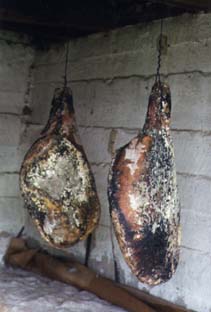
Hams and shoulders stay in cure for about 2 days per pound. After the curing period, I just brush off the salt leaving a thin coating of attached spices and hang. Contrary to many recommendations, I never wash or wrap meat that I am going to hang. It has been my experience that wrappings keep moisture in promoting excessive mold and spoilage. Some mold is desirable and does not indicate problems. There are a lot of things that can go wrong in curing hams. I remember going with my father to buy country hams as a young boy back in the fifties. Country stores would buy locally cured hams for sale. After discussing curing methods and inspecting the hams, the storekeeper would pull out a thin bladed pocket knife and insert it into the face of the ham right next to the bone (the most likely place to find spoilage and skippers). The aroma of that blade drawn from a properly cured ham is unforgettable (it is pretty hard to forget the smell of a bad one too!). Shoulders don't age as well as hams and should be used within six months or so. Hams only get better with age but small ones tend to dry out. I have some forty pounders that are Y2K comliant! (written in 1996 and yes, they were wonderful in 2000 and 2001.)

One year old hams

Lightly fried slice of 5 year old salt and molasses cured ham (no smoke or nitrates). Note white flecks and color.

More pictures


Next - Bacon